Long before the concept of a curated digital identity or the modern personal branding agency, Aleister Crowley engineered one of the most enduring, controversial, and meticulously crafted personas in history. Known to the world as 'The Great Beast 666,' his approach to self-mythology was unparalleled. In this comparison and alternatives analysis, we examine how Aleister Crowley crafted his ultimate 'bio' through esoteric mottos, provocative titles, and sheer audacity. Furthermore, we will compare his historical branding to modern occult alternatives and digital spiritual influencers to see what today's creators can learn from the ultimate master of esoteric self-promotion.
Quick Facts: The Man Behind the Myth
| Attribute | Details |
|---|---|
| Full Name | Edward Alexander Crowley |
| Born | October 12, 1875 (Royal Leamington Spa, England) |
| Died | December 1, 1947 (Hastings, England) |
| Nationality | British |
| Known For | Founding Thelema, Occultism, Poetry, Mountaineering |
| Core Philosophy | 'Do what thou wilt shall be the whole of the Law.' |
| Digital Legacy | Managed by O.T.O., esoteric archives, and modern occult communities |
The Original 'Bio': Aleister Crowley's Mottos and Titles
Today, an Instagram bio relies on emojis, keywords, and a link tree to establish authority. Crowley’s equivalent was the magical motto. Upon joining the Hermetic Order of the Golden Dawn in 1898, members were required to adopt a Latin moniker. While others chose passive or mystical phrases, Crowley selected Perdurabo—translated as 'I will endure to the end.' This was not just a username; it was a lifelong mission statement and a psychological anchor.
As his brand evolved, so did his titles. He adopted 'The Great Beast 666' (drawing from the Book of Revelation) and 'To Mega Therion' (Greek for The Great Beast). These weren't merely shock tactics; they were calculated branding choices designed to position him as a prophetic figure ushering in a new aeon. If Crowley were alive today, his bio wouldn't read 'Author | Speaker | Entrepreneur.' It would read 'Prophet of the New Aeon | Founder of Thelema | Perdurabo.' He understood that to build a cult of personality, one must adopt titles that demand curiosity and command authority.
Digital Footprint: Social Media Presence & Legacy Pages
Though Crowley passed away in 1947, his digital footprint is massive. On platforms like TikTok and Instagram, the hashtag #AleisterCrowley garners tens of millions of views. However, analyzing his 'social media presence' requires looking at how his brand is maintained by legacy organizations versus modern digital communities.
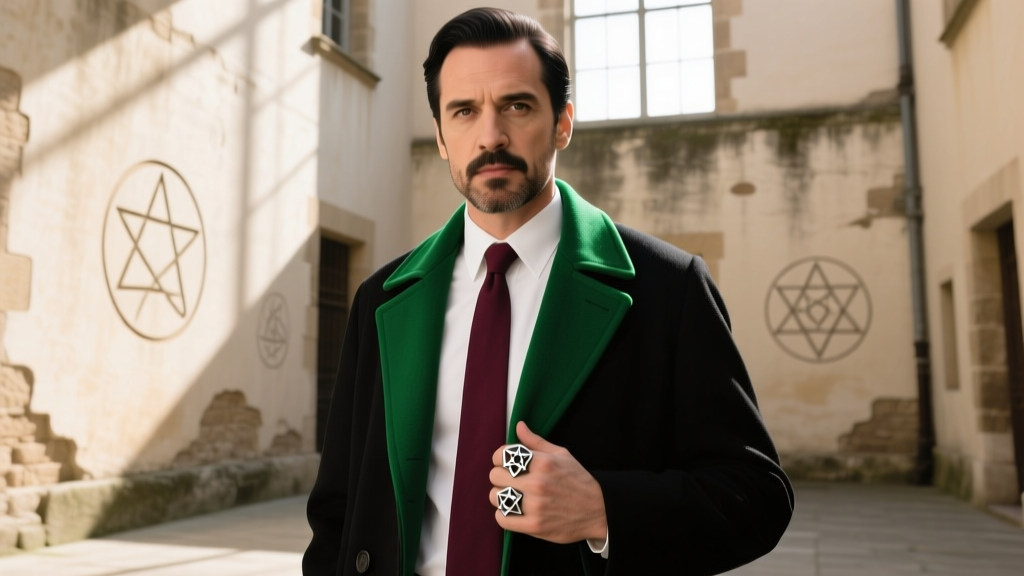
The official Ordo Templi Orientis (O.T.O.) maintains a highly structured, academic, and traditional web presence. Their digital 'bio' is rooted in historical preservation, offering dense theological texts and charter information. Conversely, modern fan pages and 'WitchTok' creators utilize Crowley as an aesthetic symbol of rebellion. His iconic 1912 portrait, with its piercing gaze and bohemian attire, is frequently used in 'dark academia' and 'occultcore' mood boards. Crowley’s visual brand was so strong that his image alone communicates a specific subcultural alignment without a single word of context.
Comparison: Crowley vs. Modern Occult Alternatives
To truly understand Crowley’s branding genius, we must compare his approach to alternative esoteric figures and modern spiritual influencers.
Aleister Crowley vs. Anton LaVey
Anton LaVey, founder of the Church of Satan in 1966, is often viewed as a modern alternative to Crowley. However, their branding strategies were vastly different. LaVey’s brand was built on theatricality, media stunts, and accessible, edgy shock value (e.g., black masses, carnivals). LaVey’s 'bio' was the ultimate rebel. Crowley, on the other hand, branded himself as an aristocratic scholar and a divine prophet. Crowley’s writings, like The Book of the Law, are dense and cryptic. Where LaVey offered an accessible alternative to mainstream religion, Crowley offered a complex, demanding spiritual system. For modern personal branding, LaVey represents the 'edgy disruptor,' while Crowley represents the 'elite visionary.'
Crowley vs. Modern Digital Spiritual Influencers
Today’s digital tarot readers and astrology influencers brand themselves around 'healing,' 'safe spaces,' and 'positive vibes.' Their bios are welcoming and inclusive. Crowley’s brand was intentionally polarizing, elitist, and intimidating. He famously declared, 'I am the snake that giveth Knowledge & Delight,' embracing the role of the villain in the eyes of Edwardian society. The alternative to modern 'light and love' branding is Crowley’s 'shadow and will' branding. He teaches us that you do not need to be universally liked to build a dedicated, lifelong following; you only need to be deeply understood by your target audience.
Published Works & Esoteric Branding
A strong personal brand requires a content engine. Crowley’s 'content pillars' were his published works, which he used to cement his authority. The Book of the Law (Liber AL vel Legis) served as his foundational manifesto. Magick in Theory and Practice established his technical authority, while The Book of Thoth (accompanied by the visually stunning Thoth Tarot deck painted by Lady Frieda Harris) provided a visual and interactive entry point into his brand.
This multi-medium approach is a masterclass in personal branding. He didn't just write about his philosophy; he created tools (the Tarot), rituals (the Gnostic Mass), and organizations (the A∴A∴ and O.T.O.) that allowed his followers to actively participate in his brand ecosystem.
Personal Branding Takeaways for Modern Creators
What can modern professionals, artists, and creators learn from the branding of Aleister Crowley? Here are the core takeaways to apply to your own digital bio and online presence:
- Craft a Powerful Moniker or Motto: Just as 'Perdurabo' guided Crowley’s life, find a core phrase that encapsulates your professional mission. Use this as your headline or bio tagline to instantly communicate your values.
- Embrace Polarization: Crowley did not care about being universally beloved; he cared about being remembered. If your brand tries to appeal to everyone, it will resonate with no one. Don't be afraid to take a definitive stance in your niche.
- Build an Ecosystem, Not Just a Profile: Crowley didn't just write books; he created the Thoth Tarot and established lodges. Translate this to the digital age by creating interactive assets—templates, communities, or tools—that allow your audience to engage with your brand beyond just reading your posts.
- Master Visual Consistency: Crowley’s bohemian robes, piercing gaze, and curated photography created an unmistakable visual identity. Ensure your profile pictures, color palettes, and visual assets consistently reflect the 'era' or 'vibe' of your personal brand.
Sources & Further Reading
- Kaczynski, Richard. Perdurabo: The Life of Aleister Crowley. North Atlantic Books, 2010.
- Ordo Templi Orientis (O.T.O.). Official Archives and History. oto-usa.org
- Encyclopædia Britannica. 'Aleister Crowley | British Occultist, Writer, & Mountaineer.' britannica.com