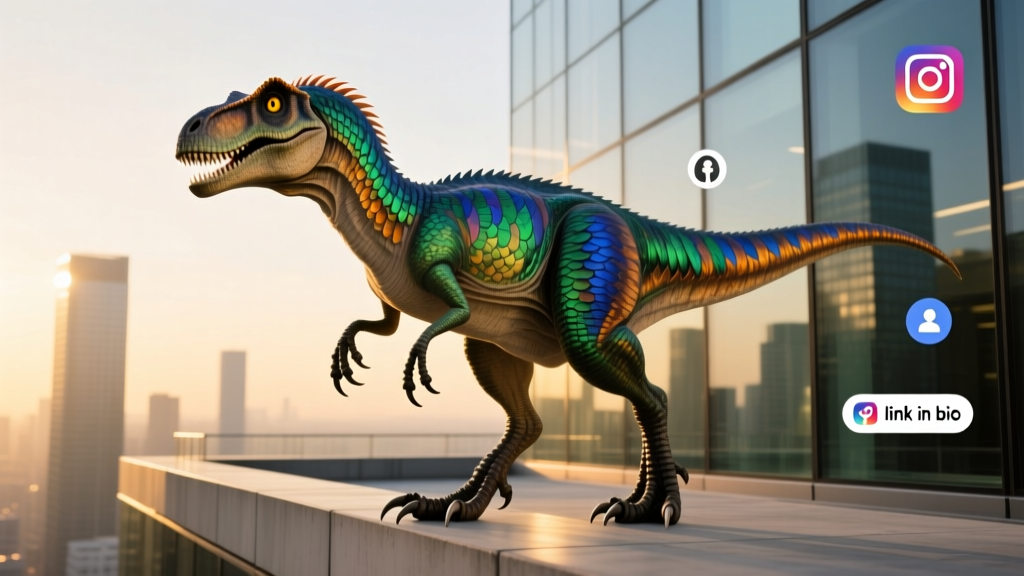
When building a personal brand, few icons command as much respect in their niche as Dino Deinonychus. While not a human influencer, this Early Cretaceous dromaeosaurid is the undisputed heavyweight champion of paleontological branding. Discovered by John Ostrom in the 1960s, Dino Deinonychus completely rebranded the public perception of dinosaurs from sluggish, tail-dragging reptiles to active, bird-like predators. In this comparison and alternatives analysis, we break down the social media presence, cultural branding, and digital legacy of this prehistoric star, showing you how to apply these fierce branding strategies to your own Instagram bio and personal profile.
| Attribute | Details |
|---|---|
| Full Name | Deinonychus antirrhopus (Stage Name: Dino Deinonychus) |
| Born | Early Cretaceous (approx. 115–108 Million Years Ago) |
| Nationality | North American (Montana & Wyoming Fossil Beds) |
| Known For | Sparking the Dinosaur Renaissance, Inspiring Jurassic Park |
| Social Handles | #Deinonychus, #Dromaeosaurid, #PaleoArt, #DinoRenaissance |
The Ultimate PR Pivot: Rebranding Dino Deinonychus
Before the late 1960s, the 'dinosaur' brand was toxic. The public and scientific consensus viewed them as evolutionary failures—slow, stupid, and doomed to extinction. Enter Dino Deinonychus. When paleontologist John Ostrom published his groundbreaking monograph in 1969, he didn't just introduce a new species; he executed the greatest PR pivot in the history of science. Deinonychus, with its large brain, forward-facing eyes, and lethal sickle-shaped toe claw, proved that dinosaurs were agile, warm-blooded, and highly active.
From a personal branding perspective, this was a masterclass in disruptive positioning. Dino Deinonychus didn't try to out-size the legacy brands; it out-maneuvered them. By aligning its brand with avian ancestry and high intelligence, Deinonychus carved out a fiercely loyal niche. Today, the 'Dino Deinonychus' brand represents scientific accuracy, agility, and the courage to challenge established paradigms. It is the ultimate case study in how changing the narrative can completely revitalize a stagnant personal brand.
Comparison & Alternatives: Deinonychus vs. Pop-Culture Rivals
When analyzing the paleo-celebrity landscape, it is crucial to compare the Dino Deinonychus brand against its primary market alternatives. Each represents a different branding strategy that you can apply to your own social media presence.
Alternative 1: The 'Velociraptor' Brand (The Mainstream Sell-Out)
In 1993, Hollywood needed a villain for Jurassic Park. They took the physical proportions and pack-hunting behavior of Deinonychus but slapped the 'Velociraptor' name tag on it for marketing purposes. The Velociraptor brand is the ultimate mainstream juggernaut: highly recognizable, deeply commercialized, but scientifically inaccurate. Branding Lesson: If you want mass, mainstream appeal and viral TikTok fame, the 'Velociraptor' strategy works. However, you sacrifice niche authority and authenticity. Deinonychus remains the 'indie darling' for those who value truth over trends.
Alternative 2: The 'T-Rex' Brand (The Legacy Heavyweight)
Tyrannosaurus Rex is the Coca-Cola of paleontology. It relies on sheer size, brute force, and legacy recognition. The T-Rex brand doesn't need to be agile or clever; it just needs to show up and roar. Branding Lesson: This is the 'industry giant' strategy. Unless you already have massive institutional backing or a decade of prior fame, trying to out-muscle the T-Rex in your Instagram bio is a losing battle. You cannot out-shout a legacy brand.
Alternative 3: The 'Utahraptor' Brand (The Niche Disruptor)
Discovered later and significantly larger than Deinonychus, Utahraptor is the newer, heavier alternative. It has less name recognition but higher impact metrics. Branding Lesson: This represents the 'new tech startup' approach. It is highly effective in specialized B2B markets but lacks the cultural storytelling of Deinonychus.
Ultimately, the Dino Deinonychus brand wins on influence per capita. It changed the world not by being the biggest, but by being the most paradigm-shifting.
Social Media Presence and Digital Engagement
Because Dino Deinonychus is a prehistoric icon, its 'social media team' consists of a decentralized network of museum curators, paleoartists, and science communicators. Analyzing the digital footprint of #Deinonychus on platforms like Instagram and X (formerly Twitter) reveals fascinating engagement patterns.
Unlike the #TRex hashtag, which is flooded with memes, merchandise, and low-effort content, the #Deinonychus and #Dromaeosaurid tags are dominated by high-quality, scientifically rigorous paleoart. Influential science illustrators use Deinonychus as a canvas to showcase the latest research on feathered dinosaurs. When a paleoartist posts a meticulously rendered, feathered Deinonychus, the engagement is highly qualitative: long comment threads discussing plumage biology, biomechanics, and fossil evidence.
Furthermore, institutional accounts like the Smithsonian and the Field Museum leverage the Deinonychus brand to drive educational engagement. By positioning Deinonychus as the 'smart' dinosaur, these accounts attract a demographic of followers who are deeply invested in STEM education. For a personal brand, this mirrors the strategy of creating 'thought leadership' content on LinkedIn or Instagram carousels. You might get fewer casual likes than a meme page, but you attract high-value followers, recruiters, and collaborators who respect your expertise.
Career Highlights and Scientific Milestones
Every great celebrity has a definitive filmography or discography. The 'career' of Dino Deinonychus is marked by several world-changing milestones that cemented its legacy:
- 1964 (The Discovery): John Ostrom and Grant Meyer uncover the first fossils in the Cloverly Formation, Montana. The 'star' is born.
- 1969 (The Debut Album): Ostrom publishes Osteology of Deinonychus antirrhopus, a monograph so influential it single-handedly ignites the 'Dinosaur Renaissance.'
- 1974 (The Critical Acclaim): Ostrom publishes further research linking Deinonychus and other theropods directly to the evolutionary lineage of modern birds.
- 1993 (The Blockbuster Cameo): While not named directly, Deinonychus serves as the primary anatomical and behavioral inspiration for the 'Velociraptors' in Steven Spielberg's Jurassic Park, securing its indirect pop-culture immortality.
- 2000s-Present (The Visual Rebrand): As fossil evidence from related dromaeosaurs in China confirms the presence of feathers, the Deinonychus brand undergoes a massive visual update, transitioning from scaly green reptile to a vibrant, feathered predator in modern media.
Personal Branding Takeaways for Your Bio
What can a 100-million-year-old feathered predator teach you about crafting the perfect Instagram bio or LinkedIn profile? The legacy of Dino Deinonychus offers three actionable takeaways for your personal branding strategy:
1. Own Your Niche Authority (Be the Deinonychus of Your Industry)
Don't try to be a generic T-Rex. If you are a graphic designer, don't just write 'I make cool logos.' Channel the Deinonychus energy: 'Translating complex brand psychology into high-conversion visual systems.' Be specific, be agile, and target the audience that values precision over brute force.
2. Embrace the Rebrand
When the scientific community discovered that dromaeosaurs likely had feathers, the old 'scaly lizard' imagery was rendered obsolete. Museums and artists didn't cling to the old brand out of nostalgia; they adapted to the new data. If your industry shifts, or if you pivot your career from corporate finance to sustainable consulting, update your bio immediately. A stagnant brand is a dead brand. Use your bio to highlight your evolution, not just your origins.
3. Let Your 'Claws' Show in Your Hook
Deinonychus is famous for its terrifying, sickle-shaped pedal claw—a unique selling proposition (USP) that made it instantly recognizable. Your social media bio needs a 'sickle claw.' This is your hook, your unique metric, or your boldest claim. Instead of 'Coffee lover and marketer,' try 'Scaled 3 SaaS startups from $0 to $5M ARR. Now helping founders build their growth engines.' Show your lethal competence right at the top of your profile.
Sources and Further Reading
To dive deeper into the science and branding of this incredible paleo-celebrity, consult the following foundational texts and archives:
- Ostrom, J. H. (1969). Osteology of Deinonychus antirrhopus, an unusual theropod from the Lower Cretaceous of Montana. Peabody Museum of Natural History Bulletin 30. (The foundational text that started the Dinosaur Renaissance).
- Smithsonian Magazine Archives: How the Dinosaur Renaissance Changed Science. (Explores the cultural impact of Ostrom's discoveries on public perception).
- Natural History Museum (London) Online Database: Dromaeosauridae and the Avian Connection. (Provides up-to-date taxonomic and visual branding context for feathered theropods).