When analyzing the evolution of sports media, the personal brand of Frank Gifford stands as a masterclass in longevity, authority, and crossover appeal. Long before Instagram bios, TikTok highlights, and athlete-run podcasts defined sports marketing, Gifford crafted an analog persona that resonated with millions for over half a century. Today, as modern athletes and broadcasters build hyper-curated digital footprints, looking back at Gifford offers a fascinating comparison. How does a mid-century sports icon's legacy brand hold up against today's digital alternatives? For professionals and creators looking to craft their own personal brand, the 'Gifford Model' provides timeless lessons in authority, aesthetic consistency, and career pivoting that no viral social media trend can replicate.
Quick Facts: The Man Behind the Monday Night Mic
| Attribute | Details |
|---|---|
| Full Name | Francis Newton Gifford |
| Born | August 16, 1930 (Santa Monica, California) |
| Died | August 9, 2015 (Greenwich, Connecticut) |
| Nationality | American |
| Known For | NY Giants Halfback (1956 NFL MVP), Monday Night Football Broadcaster |
| Social Media Handles | Legacy/Estate managed (No active personal accounts; memorialized via @ESPN, @ProFootballHOF) |
The Analog Bio: Building a Brand Before Social Media
In the 1950s and 60s, an athlete's 'bio' was not a 150-character digital summary; it was communicated through broadcast intros, print media profiles, and network PR. Gifford’s brand was defined as 'The Gentleman of the Gridiron.' He was a rare crossover star who appeared in Hollywood films, graced the covers of mainstream magazines, and starred in high-profile commercials. His personal brand was built on a foundation of undeniable competence—winning the 1956 NFL MVP award and earning eight Pro Bowl selections—paired with a suave, approachable public persona. When he transitioned to broadcasting, he didn't need a digital bio to prove his expertise; his resume was etched into the cultural consciousness. For modern creators, this highlights a crucial lesson: your bio is only as strong as the tangible work that backs it up.
Comparison Analysis: The Frank Gifford Model vs. Modern Alternatives
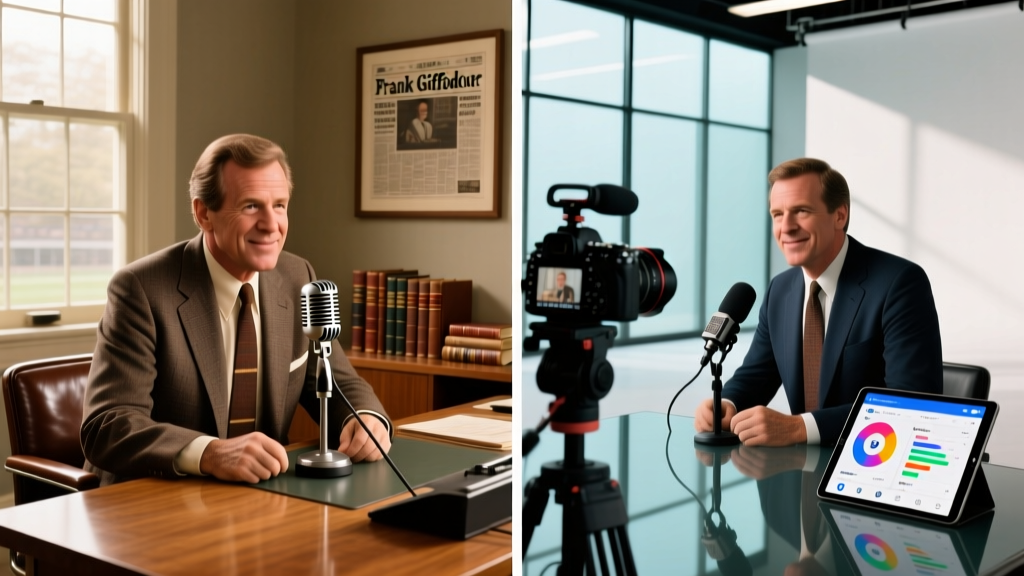
To truly understand Gifford's branding genius, we must compare his approach to both his historical contemporaries and modern digital alternatives. During his peak on ABC's Monday Night Football, Gifford was positioned against Howard Cosell. Cosell’s brand was abrasive, controversial, and highly theatrical. Gifford, by contrast, was the 'straight man'—the calm, analytical, and universally respected voice of reason. This dynamic created a perfect broadcasting ecosystem.
Fast forward to today's sports media landscape, and we see a stark contrast between the 'Gifford Model' and modern alternatives like Pat McAfee, Jason Kelce, or Nick Wright. The modern 'Creator Economy' alternative relies on raw, unfiltered, high-volume content. Today's athlete-influencers build brands on viral hot-takes, casual podcast aesthetics, and direct-to-fan controversy. While this modern alternative generates massive short-term engagement, it often lacks the corporate longevity and mainstream crossover appeal that Gifford enjoyed.
Furthermore, comparing Gifford to modern ex-player analysts like Tony Romo reveals a shift in digital branding. Romo’s brand is heavily tied to viral predictive moments shared across Twitter/X and TikTok. Gifford’s brand, however, was built on week-over-week reliability and mainstream television authority. When writing your own bio or planning your content strategy, you must choose your lane: Are you optimizing for the raw, viral 'Creator' alternative, or are you building a polished, authoritative 'Institution' brand?
Career Highlights: From the Gridiron to the Broadcast Booth
Gifford’s personal brand was forged in the fires of incredible adversity, a narrative arc that modern publicists would kill to script. After a stellar start with the New York Giants, his career was nearly ended by a brutal, infamous tackle from Chuck Bednarik in 1960. The injury forced him into retirement for over a year. However, his 1962 comeback solidified his brand as a resilient competitor. After retiring from football, Gifford seamlessly pivoted to media. He joined CBS in 1971 before making his legendary move to ABC's Monday Night Football in 1977. Spending 27 years on the premier stage of American television, he won an Emmy Award and became the face of NFL broadcasting. According to his Pro Football Hall of Fame profile, his ability to articulate complex game strategies to a casual audience made him the gold standard for sports communication.
Social Media Presence & The Digital Estate
Because Frank Gifford passed away in 2015, he does not have an active, personal Instagram or TikTok account. So, how does a legacy figure exist on social media? His 'bio' is now maintained by institutions. His digital footprint is a tapestry of ESPN Classic retrospectives, YouTube broadcast archives, and tribute posts from the Pro Football Hall of Fame. As noted in his New York Times obituary, Gifford's impact transcended the sport itself. On platforms like X (formerly Twitter) and Instagram, engagement with Gifford's legacy is driven by nostalgia, historical appreciation, and network-led storytelling. For modern professionals, this 'digital estate' concept is vital to consider: long after you stop posting daily updates, your digital footprint will be defined by the institutional archives, articles, and high-value collaborations you leave behind. A well-crafted LinkedIn summary or a professional portfolio website acts as your permanent digital plaque.
Personal Branding Takeaways for Your Own Bio
What can today’s entrepreneurs, freelancers, and creators learn from a mid-century football star when writing their Instagram or LinkedIn bios? Here are four actionable takeaways inspired by the Gifford legacy:
1. Lead With Your Highest Credential (The 'MVP to Emmy' Pipeline)
Gifford never let the audience forget he was an NFL MVP before he was a broadcaster. In your own bio, anchor your personal brand with your most undeniable achievement. If you have a major certification, a notable client, or a specific metric of success, it belongs in the very first line of your digital bio to establish immediate authority.
2. Visual and Tonal Consistency is Your Uniform
Gifford was rarely seen without a tailored suit and a measured, baritone delivery. His visual and auditory branding was immaculate. Audit your social media profiles: does your profile picture, color palette, and caption tone reflect the premium professional you claim to be? Consistency builds trust.
3. The Power of the 'Straight Man' Positioning
In a digital feed exhausted by loud, controversial hot-takes and clickbait, positioning yourself as the calm, analytical expert makes you a magnet for high-value collaborations. Your bio doesn't need to be edgy to be effective; it needs to be clear, authoritative, and reliable.
4. Build an Analog Foundation for Digital Success
Gifford’s brand was built on live, unedited, long-form television. Today, that translates to mastering long-form content—like in-depth newsletters, comprehensive case studies, or long-form podcasts—before chasing short-form viral trends. Use your social media bio to funnel audiences toward your deep-dive, high-value work, rather than just your viral moments.