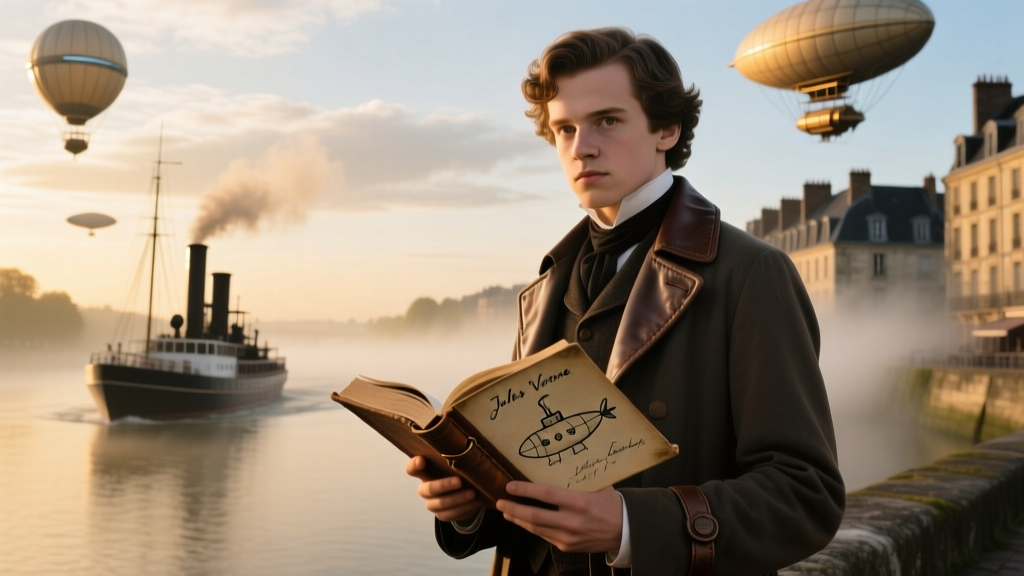
Long before the concept of a personal brand or an Instagram bio existed, Jules Verne engineered a literary identity so powerful that it transcends centuries. Today, the name Jules Verne is not just a historical author; it is a globally recognized brand synonymous with retro-futurism, exploration, and scientific imagination. For modern creators looking to craft a compelling online presence, examining the history and origin story of this French visionary offers a masterclass in niche authority, visual consistency, and world-building.
By understanding how Verne transformed from a struggling Parisian stockbroker into the undisputed father of science fiction, we can extract actionable branding lessons for our own digital profiles. Let us dive into the archives and explore the origins of a timeless brand.
The Origin Story: From the Ports of Nantes to Paris
Gabriel Jules Verne was born on February 8, 1828, in Nantes, a bustling French port city. This maritime environment was the crucible of his imagination. Watching ships arrive from distant colonies and listening to sailors' tales embedded a lifelong obsession with travel, geography, and the unknown into his psyche. His father, Pierre Verne, a prosperous lawyer, expected his son to follow a conventional, respectable path in law.
In 1847, Verne was sent to Paris to study law. However, the vibrant literary salons of the French capital quickly derailed his legal ambitions. He befriended literary giants like Alexandre Dumas and began writing plays and librettos. To appease his father and pay his bills, Verne took a job as a stockbroker (agent de change) at the Paris Bourse. Yet, his true work happened in the early hours of the morning. Before the markets opened, Verne was in the Bibliothèque Nationale, researching science, geography, and history, meticulously taking notes that would later form the bedrock of his fictional universe.
This dual life—the pragmatic financier by day and the visionary world-builder by dawn—is a testament to his discipline. Verne did not wait for inspiration; he treated his craft with the rigor of a scientist, a branding trait that would later define his authoritative voice in literature.
The Hetzel Partnership: Engineering a Franchise Brand
The turning point in Verne's career—and the birth of his 'brand'—occurred in 1862 when he met publisher Pierre-Jules Hetzel. Hetzel was not just a printer; he was a master marketer and editor. Recognizing the unique potential in Verne's manuscript Five Weeks in a Balloon, Hetzel proposed an unprecedented contract: a long-term series dedicated entirely to Verne's geographical and scientific novels.
Hetzel branded this series the Voyages Extraordinaires (Extraordinary Voyages). This was an early masterclass in franchise branding. Hetzel ensured that every book in the series featured uniform, highly recognizable physical branding: the iconic red and gold bindings, specific typography, and lavish, meticulously researched illustration plates. Readers did not just buy a book; they bought into a curated, visually consistent collection. Hetzel also serialized the stories in his family magazine, Magasin d'Éducation et de Récréation, building massive anticipation and community engagement long before the hardcover releases. This strategy of 'content drops' and serialized storytelling is exactly what modern influencers use on platforms like Patreon and Substack today.
Quick Facts: The Architect of Tomorrow
| Attribute | Details |
|---|---|
| Full Name | Gabriel Jules Verne |
| Born | February 8, 1828 (Nantes, France) |
| Nationality | French |
| Known For | Pioneering Science Fiction, The Voyages Extraordinaires Series |
| Key Works | Twenty Thousand Leagues Under the Sea, Around the World in Eighty Days |
| Digital Legacy Handles | @museejulesverne (Official Museum IG), Various Estate Archives |
Core Bibliography: Building a Cinematic Universe
Verne’s bibliography is not just a list of books; it is an interconnected universe. Much like modern cinematic universes, Verne’s works often shared characters, technologies, and thematic DNA. Vingt Mille Lieues sous les mers (Twenty Thousand Leagues Under the Sea, 1870) introduced the enigmatic Captain Nemo and the submarine Nautilus. Nemo's backstory was later expanded in L'Île mystérieuse (The Mysterious Island, 1874), rewarding dedicated fans with deeper lore.
Other monumental works include Le Tour du monde en quatre-vingts jours (Around the World in Eighty Days, 1872), which capitalized on the era's fascination with global transit and the newly opened Suez Canal, and De la Terre à la Lune (From the Earth to the Moon, 1865), which showcased his dedication to mathematical and physical plausibility. By grounding his wild imagination in hard data, Verne established a brand voice of 'plausible wonder' that set him apart from pure fantasy writers.
Digital Legacy: Jules Verne on Modern Social Media
Though Verne passed away in 1905, his digital footprint is meticulously managed by historical societies, publishers, and the official Musée Jules Verne in Nantes. Analyzing the social media presence of accounts like the official museum on Instagram (@museejulesverne) reveals how a historical figure's brand is adapted for the visual web.
The visual identity of the Verne brand online relies heavily on the 'steampunk' and 'retro-futurism' aesthetics. Instagram grids dedicated to his legacy utilize a distinct color palette: sepia tones, brass and copper textures, deep oceanic blues, and vintage parchment. The posting style mixes high-resolution scans of Hetzel's original 19th-century illustrations with behind-the-scenes looks at historical manuscripts and modern pop-culture homages.
Engagement on these legacy pages thrives on niche community building. By leaning heavily into specific subcultures—such as vintage science enthusiasts, steampunk cosplayers, and maritime historians—the Verne brand maintains high relevance. The bio of the official museum accounts typically highlights his status as a 'visionary' and 'Nantes native,' anchoring his global legacy to a specific, visitable geographic location, which drives both digital engagement and physical tourism.
Personal Branding Takeaways for Your Profile
What can modern creators, freelancers, and entrepreneurs learn from a 19th-century French novelist? Here are four personal branding takeaways you can apply to your own Instagram bio and digital presence:
- 1. Niche Down to 'Plausible Wonder': Verne did not just write fiction; he wrote roman de la science. He found the exact intersection between his passion (storytelling) and his research (science/geography). Bio Tip: In your Instagram bio, combine your creative skill with your specific industry knowledge. Instead of 'Writer,' use 'Translating Complex Tech into Human Stories.'
- 2. Visual Consistency is Your 'Hetzel Binding': The red and gold Hetzel editions made Verne's books instantly recognizable on a crowded shelf. Bio Tip: Treat your Instagram grid like a bookshelf. Use a consistent color palette, font style, and visual motif in your highlights and posts so your profile is instantly recognizable to new visitors.
- 3. Leverage Your Origin Story: Verne’s identity was deeply tied to the port city of Nantes, which gave his work authenticity. Bio Tip: Don't hide your roots. Use your location or your unique background in your bio to build trust and give context to your journey (e.g., 'Designing from the Pacific Northwest 🌲' or 'Former Teacher turned UX Designer').
- 4. Build a Universe, Not Just a Feed: Verne rewarded readers who followed his entire series with interconnected lore. Bio Tip: Use your Instagram Highlights to create 'chapters' of your brand. Create dedicated highlight reels for your 'Origin Story,' your 'Process,' and your 'Core Beliefs' to turn casual profile visitors into dedicated community members.
Sources & Further Reading
To dive deeper into the life, history, and enduring brand of this literary pioneer, consult the following verified archives: