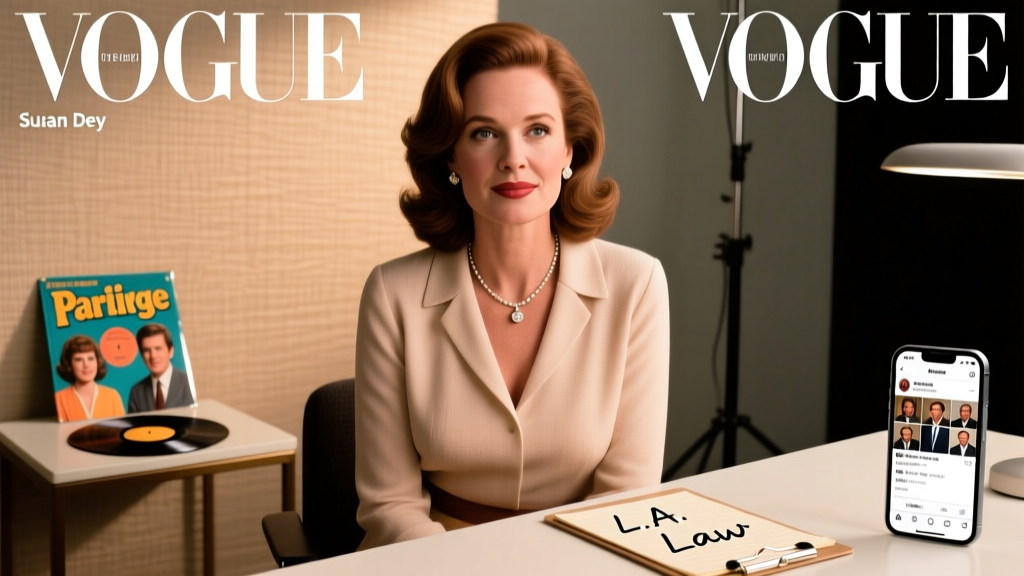
When television historians discuss the most successful transitions from manufactured teen idol to respected, award-winning dramatic actress, Susan Dey inevitably anchors the conversation. Unlike many child stars who fade into obscurity or struggle with the relentless public eye, Dey engineered one of the most remarkable career pivots in Hollywood history. Beyond her on-screen triumphs, her approach to public life—and specifically her modern digital footprint—offers a masterclass in personal branding through absence. To understand the enduring power of her legacy, we must explore the Susan Dey origin story, tracing her journey from a small-town Illinois girl to a television icon who ultimately chose the quiet power of privacy over the noise of social media.
The Origin Story: Small-Town Roots to Hollywood Stardom
Born Susan Hallock Dey on December 10, 1952, in Pekin, Illinois, her early life was far removed from the glitz and glamour of the entertainment industry. Her father, Robert Dey, was a local journalist, and her mother, Ruth, was a dedicated nurse. Tragedy struck early when her mother passed away, a profound loss that shaped Dey’s resilient, independent spirit and grounded perspective on life. Following her parents' divorce and her mother's death, a teenage Susan moved to New York City to live with her aunt.
It was in Manhattan that her origin story took a fateful turn. With no formal acting training or theatrical aspirations, she began modeling for the prestigious Ford Modeling Agency. Her striking, approachable girl-next-door look quickly caught the attention of casting directors who were searching for a new ABC sitcom about a widowed mother and her children who form a pop band. In 1970, at just 17 years old, Dey was cast as Laurie Partridge in The Partridge Family. The show became a massive cultural phenomenon, instantly transforming the small-town girl into a global teen idol, complete with fan clubs, magazine covers, and a permanent place in 1970s pop culture history.
Quick Facts: Profile of a Television Pioneer
| Attribute | Details |
|---|---|
| Full Name | Susan Hallock Dey |
| Born | December 10, 1952 (Pekin, Illinois) |
| Nationality | American |
| Known For | The Partridge Family, L.A. Law |
| Social Media Handles | None (Strictly Private / Unverified Fan Pages) |
Career Evolution: Breaking the Teen Idol Mold
The transition from a beloved sitcom teenager to a serious, bankable actress is a notorious graveyard for many Hollywood careers. Typecasting is a formidable barrier, but Dey was fiercely determined to dismantle the Laurie Partridge image. Her first major step toward dramatic credibility was the 1978 film First Love, a mature coming-of-age story that signaled her intent to tackle complex, adult themes. She followed this with stage work and television movies, slowly chipping away at the public's perception of her as merely a pop-star actress.
However, her true renaissance arrived in 1986 with the groundbreaking NBC legal drama L.A. Law. Cast as Deputy District Attorney Grace Van Owen, Dey shed her teen idol skin entirely. Van Owen was sharp, ambitious, morally complex, and fiercely intelligent, navigating high-stakes courtroom battles and a highly publicized, controversial romance with defense attorney Mark McKenzie (played by Mark Harmon). The role was a revelation. It proved to critics and audiences alike that Dey possessed formidable dramatic range and commanding screen presence.
Her portrayal of Grace Van Owen earned her multiple Emmy nominations and a Golden Globe Award for Best Actress in a Television Series Drama in 1988. She later anchored the CBS drama Family Law (1999–2002) as lawyer Laurie Collier, cementing her legacy as a staple of premium television drama before quietly and deliberately stepping away from the acting industry in the early 2000s.
Susan Dey's Social Media Presence: The Art of Digital Absence
In an era where celebrities are expected to document every meal, workout, and behind-the-scenes moment on Instagram and TikTok, Susan Dey’s social media presence is defined by a striking, deliberate void. She does not have an official, verified Instagram, Twitter, Facebook, or TikTok account. Any profiles bearing her name are fan-run tribute pages or unverified imitations. From a modern personal branding perspective, this is not a failure to adapt; it is a profound, highly effective branding choice.
Dey belongs to a rare echelon of legacy stars who maintain their mystique through digital scarcity. By refusing to participate in the attention economy, she ensures that her public image remains permanently frozen in the dignity of her professional work rather than the fleeting trivialities of social media feeds. Her digital bio is not a string of emojis, sponsored hashtags, and link-trees; it is her IMDb page, her Golden Globe, and the enduring syndication of her television classics. This absence creates a vacuum that fans fill with nostalgia, respect, and a deep appreciation for the boundaries she has set between her public art and her private life.
Personal Branding Takeaways: Curating Your Digital Legacy
What can modern professionals, creators, and personal brand builders learn from an actress who refuses to use social media? Surprisingly, a great deal. The 'Susan Dey Method' of branding offers vital lessons for anyone looking to refine their online presence on platforms like Instagram or LinkedIn:
- 1. The Power of the Minimalist Bio: You do not need to over-explain yourself to your audience. Dey’s legacy proves that your work should be your primary identifier. For your own Instagram or LinkedIn bio, strip away the clutter. Instead of a chaotic list of hobbies and emojis, use a clean, authoritative statement of who you are and what you do. (e.g., 'SAG-AFTRA Actress | Represented by [Agency] | Portfolio below' is far more effective than 'Actor | Dog Mom | Coffee Lover | DM for Collabs').
- 2. Embrace Digital Scarcity: Oversharing dilutes your brand's perceived value. By holding back and maintaining a level of privacy, you create intrigue and respect. You do not need to post daily to remain relevant. Curate your feed so that every post adds distinct, undeniable value to your personal narrative.
- 3. Protect Your Professional Mystique: Dey never participated in reality television or tabloid drama, which protected her credibility as a serious dramatic actress. If you are building a professional brand, keep your public profiles focused on your expertise. Use the 'Close Friends' feature for personal updates and keep your main grid dedicated to your portfolio, milestones, and professional insights.
- 4. Let Your Portfolio Be Your Anchor: When fans or casting directors search for Dey, they are directed immediately to her body of work. Ensure your social media bio includes a high-quality, centralized link to a professional portfolio, personal website, or Linktree that showcases your best achievements without requiring the user to scroll through years of disparate posts.
Conclusion: A Legacy Etched in Television History
The Susan Dey origin story is a testament to raw talent, quiet resilience, and the courage to walk away on one's own terms. From the vibrant, bell-bottomed days of The Partridge Family to the sharp shoulder pads and intense courtroom monologues of L.A. Law, she redefined what it meant to be a television actress in America. Today, her refusal to bow to the pressures of social media serves as a powerful reminder that true personal branding is not about how much noise you can make, but about the lasting quality of the legacy you leave behind.