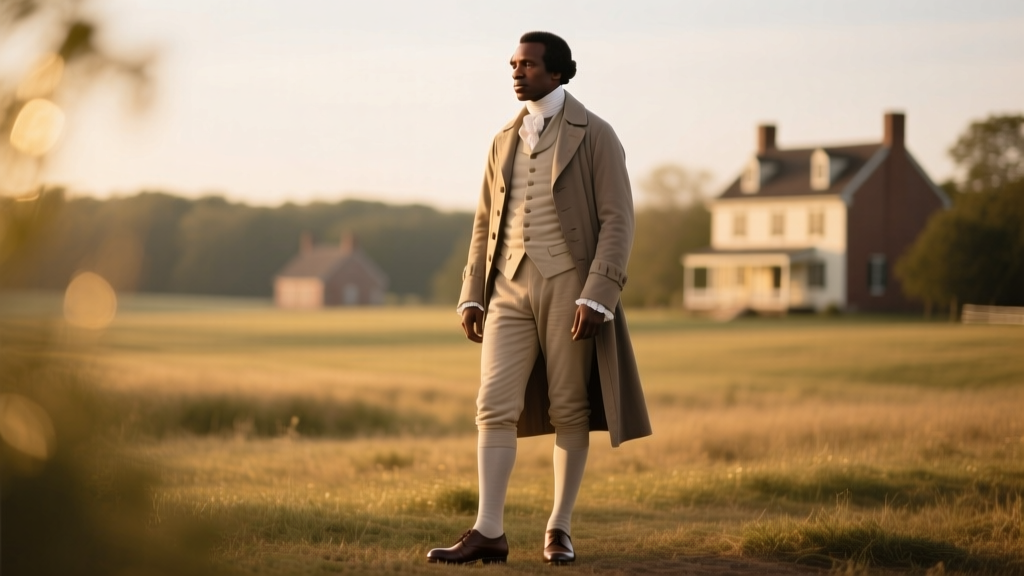
When studying the architecture of a powerful personal brand, few historical figures offer as compelling a blueprint as Benjamin Banneker. Long before the concept of digital personal branding existed, Banneker established himself as America’s preeminent polymath. Through sheer intellect and meticulous self-documentation, he crafted a legacy that defied the severe racial prejudices of the 18th century. Today, we are conducting a critical review of the Benjamin Banneker brand. By analyzing the pros and cons of his multidisciplinary approach, modern creators, scientists, and entrepreneurs can learn how to position their own diverse skill sets in a hyper-niched digital landscape.
Quick Facts: The Original American Polymath
| Attribute | Details |
|---|---|
| Full Name | Benjamin Banneker |
| Born | November 9, 1731 (Baltimore County, Maryland) |
| Died | October 19, 1806 |
| Known For | Almanac author, D.C. surveyor, astronomer, horologist |
| Modern Social Presence | Legacy managed by @NMAAHC, @Smithsonian, STEM educators |
Historical Achievements & Intellectual Legacy
To understand Banneker’s brand, we must first audit his 'portfolio.' Banneker was entirely self-taught in advanced mathematics and astronomy. In 1753, he constructed a striking clock entirely out of carved wood, which kept near-perfect time for over forty years. This artifact served as the ultimate 'proof of work,' establishing his local reputation as a master horologist and engineer.
His most significant public-facing achievement was the publication of his annual almanacs between 1792 and 1797. Banneker single-handedly calculated the ephemerides—the complex astronomical tables predicting solar and lunar eclipses, planetary positions, and tides. These almanacs were not just scientific triumphs; they were highly successful commercial products that distributed his name and intellect across the Mid-Atlantic states.
Furthermore, in 1791, Banneker was appointed to the team led by Andrew Ellicott to survey the original boundaries of the federal territory that would become Washington, D.C. His ability to maintain the delicate astronomical instruments and perform the rigorous field calculations cemented his status as a premier surveyor. Finally, his bold 1791 letter to Secretary of State Thomas Jefferson, challenging Jefferson's views on race and advocating for abolition, showcased a brand built not just on technical skill, but on unyielding moral conviction.
The Benjamin Banneker Brand: Pros & Cons
Evaluating Banneker through the lens of modern personal branding reveals the inherent strengths and weaknesses of the 'polymath' positioning strategy. Here is a critical review of the pros and cons of adopting a multidisciplinary brand identity.
Pros of the Polymath Brand
- Unassailable Authority: Banneker did not just claim to be smart; he published annual, verifiable data (the almanacs). In personal branding, consistent, high-value output builds an authority that mere self-promotion cannot achieve.
- Cross-Pollination of Audiences: By operating at the intersection of agriculture, astronomy, and horology, Banneker appealed to farmers, sailors, scientists, and politicians. A multidisciplinary brand allows you to tap into multiple, distinct networks simultaneously.
- The Mission-Driven Halo Effect: Banneker’s brand was elevated by his moral stance. His letter to Jefferson proved that his intellect was tied to a higher purpose (equality and freedom). Modern brands that attach their skills to a core social mission enjoy deeper audience loyalty.
Cons of the Polymath Brand
- The Niche Dilemma: Modern social media algorithms heavily favor hyper-specific niches. If Banneker were on Instagram today, the algorithm might struggle to categorize him. Is he a woodworking influencer? An astronomy educator? A political activist? Multidisciplinary brands often face friction when trying to scale on algorithmic platforms.
- High Barrier to Entry: The polymath brand requires immense, verifiable output across multiple fields. You cannot simply claim to be a 'Renaissance Man' in your bio; you must produce the equivalent of the wooden clock and the almanac to back it up. This leads to high creator burnout.
- Historical Misattribution Risks: When a personal brand spans too many disciplines, history (and the public) often dilutes the primary identity. Banneker’s vital role in surveying Washington D.C. is sometimes overshadowed by myths or attributed to his peers, a common risk when your brand lacks a singular, easily digestible focal point.
Social Media Presence: How Institutions Brand Banneker Today
Because Benjamin Banneker passed away in 1806, he does not possess a personal Instagram or X account. However, his digital footprint is massive, heavily curated, and actively managed by major cultural institutions, historical societies, and STEM advocacy pages. Analyzing how entities like the Smithsonian National Museum of African American History and Culture (@NMAAHC) brand Banneker on social media provides a masterclass in legacy management.
Visually, institutional accounts brand Banneker using high-contrast archival imagery, sepia-toned blueprints, and astronomical charts. The visual motif of the 'wooden clock' is frequently used as a hook for Instagram Reels and TikTok videos, leveraging the satisfying, ASMR-adjacent appeal of historical craftsmanship to capture modern attention spans.
Content pillars surrounding Banneker on social media generally fall into three categories: Educational Carousels (breaking down his ephemeris calculations), Historical Justice (highlighting his correspondence with Jefferson), and STEM Inspiration (positioning him as a foundational figure for Black scientists). For modern professionals, this demonstrates how to break a complex, multifaceted career into digestible, platform-specific content pillars without losing the core narrative of your personal brand.
Personal Branding Takeaways: Crafting a Multidisciplinary Bio
How can you apply the lessons of Benjamin Banneker to your own Instagram, LinkedIn, or personal website bio? If you have multiple passions and refuse to be boxed into a single niche, use these Banneker-inspired frameworks to structure your digital presence.
1. The 'Anchor + Orbit' Bio Formula
Banneker was primarily anchored by his identity as a mathematician and astronomer, while his other skills (surveying, clockmaking, farming) orbited this core. Structure your bio to highlight one primary 'Anchor' skill, followed by your 'Orbiting' interests.
Template: [Anchor Profession] | Exploring the intersection of [Orbit 1] & [Orbit 2] | [Core Value/Mission]
Example: Data Scientist | Exploring the intersection of predictive modeling & sustainable agriculture | Open-source advocate.
2. The 'Artifacts' Approach (Show, Don't Tell)
Banneker’s wooden clock spoke louder than any resume. In your social media strategy, use your bio link to direct followers to a digital 'artifact'—a portfolio piece, an open-source project, a published essay, or a complex case study. Your bio should tease the artifact.
Template: Building [Specific Project/Artifact] in public. [Secondary Skill] enthusiast. See the blueprints below 👇
3. Value-Driven Positioning
Banneker’s brand transcended his technical skills because he stood for intellectual freedom and equality. Modern bios are often cluttered with emojis and job titles, but lack a moral or philosophical anchor. Dedicate one line in your bio to the 'why' behind your work.
Template: [Job Title] @ [Company] | Using [Your Skill] to solve [Specific Problem] | [Personal Hobby]
Sources & Further Reading
- Smithsonian National Museum of African American History and Culture: Benjamin Banneker Legacy
- The Thomas Jefferson Encyclopedia (Monticello): Banneker and Jefferson Correspondence
- Benjamin Banneker Historical Park and Museum: Official Archives and Biography